Exterior Paint Colors: How to Choose for Curb Appeal
Author: Ryan Review by Home Remodel Guidance Editorial Team Review date First published Last updated Category: Industry Insights and Trends
Choose exterior paint colors by starting with what you cannot change, such as roof, brick, stone and driveway, then pick a body color, a trim color and an accent that share undertones. Sample on the house in sun and shade, check local covenant or historic rules, paint in the temperature range on the label, and use lead-safe practices on pre-1978 homes.
Part of the series: 5 High-Impact Upgrades to Increase Home Value
Exterior color is the first thing buyers and neighbors see, and it is one of the lower-cost ways to change how a house reads. This guide covers how to choose colors, when to paint, how to work safely, and what to check before you commit. It belongs with the other upgrades that raise a home’s value, and it pairs with the interior-focused paint color guide.
Safety note: exterior painting involves ladders and, on older homes, lead paint. Rules differ by state and city, and this guide is general information, not a substitute for a licensed professional.
How do you choose exterior paint colors?
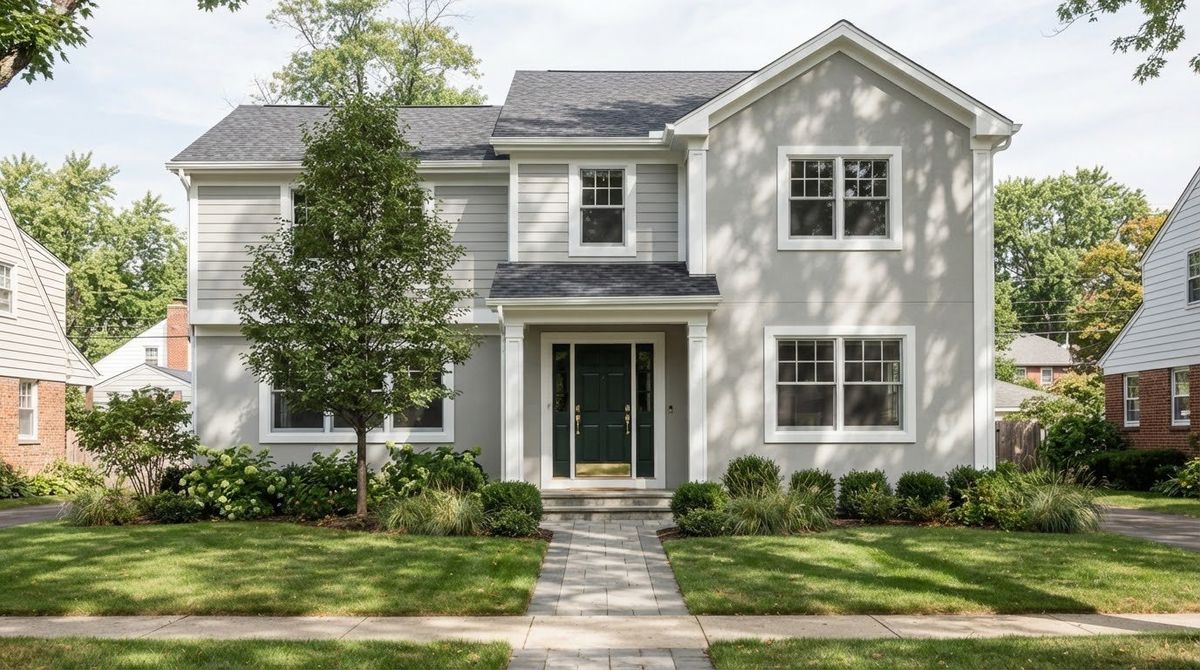
Start with what cannot change, then add color in layers. Roofing, brick, stone, stucco, the driveway and the neighbors’ houses all set limits, so match undertones to them first.
- Note fixed elements: roof, masonry, windows and any trim you are not painting.
- Choose the body color: the largest area, so it sets the mood.
- Choose trim: lighter or darker than the body, with a shared undertone.
- Choose one accent: the front door is the usual candidate.
- Sample on the house: at least two sides, in sun and shade.
Does light direction affect exterior color?
Yes. Sunlight and shade change how a color reads, and the effect is stronger outdoors than inside. Sherwin-Williams describes how north, south, east and west light differ for rooms, and the same logic applies to walls: a north wall in shade looks cooler and darker, while a south wall in sun looks warmer and brighter. Look at samples on every elevation, and again on a cloudy day and in evening light. Large trees and nearby buildings also change the look.
Which colors are brands forecasting?
For 2027, Sherwin-Williams named Celery SW 6421, a soft green, and Benjamin Moore named Webster Green HC-130, a mid-tone green. These are brand announcements made to launch palettes, not measures of what raises resale value. A green body color can suit a house surrounded by landscaping, but sample it against your roof and masonry. For more on trend sources, see home design trends for 2027, and for choices that last, design trends that stand the test of time.
What are the best exterior color combinations?
Combinations work when undertones agree and the contrast is deliberate. Three safe structures are:
- Tone-on-tone: a body color with trim one or two steps lighter and a darker door.
- Light body, dark trim: crisp edges, good for homes with strong architectural lines.
- Dark body, light trim: dramatic, and best on larger, well-detailed homes.
Pick the structure that suits your house’s size and style, and let the roof and masonry decide the undertone. Keep the number of colors to three or four, since more reads as busy.
Do you need approval for exterior paint colors?
Check before you buy paint. Many homeowner associations, condo boards and historic districts regulate exterior colors, and some require written approval or a palette. Ask your city’s planning or historic office if the home is in a district, and keep copies of approvals. If your home is a designated landmark, rules can also cover the paint removal method.
When is the best time to paint a house exterior?
Paint when the temperature, dew point and rain forecast all fit the label. Sherwin-Williams says traditional latex paint needs temperatures above 60 degrees Fahrenheit to cure properly, and that products such as Duration, Resilience and SuperPaint can be applied and cure down to 35 degrees.
Moisture matters just as much:
- Dry time before moisture: check the label for drying and recoat times, which are longer in cool weather.
- Dew: dew that forms after sunset can seep into uncured paint and cause staining and adhesion problems.
- After rain: let wood and masonry dry before painting; they absorb water.
- After application: keep the temperature within the label’s range while the paint cures.
In spring and fall, avoid days that are warm enough to paint but followed by much cooler nights, because dew can form and the paint can stop coalescing. Always follow the specific product label.
How do you prepare the surface?
Preparation decides how long the paint lasts. The surface must be dry, because excess moisture prevents absorption and can lead to peeling, according to Sherwin-Williams. Remove chalky residue on aluminum siding or the new paint will not adhere. Then:
- Wash away dirt and mildew as the paint maker directs.
- Scrape loose paint (see the lead warning below) and sand edges smooth.
- Repair rot and replace damaged wood before painting; paint over rot fails quickly.
- Caulk gaps with an exterior-grade product the paint maker approves.
- Prime bare wood, stains and repairs as the maker directs.
- Paint with two coats where the maker recommends, or one coat of a product that says it is one-coat for your surface and color change.
Does the siding material change the paint choice?
Yes, because wood, fiber cement, stucco, masonry, vinyl and aluminum take paint differently. Sherwin-Williams notes that masonry and wood absorb more moisture than aluminum or vinyl, so they need longer to dry after rain, and that aluminum siding must be free of chalkiness before painting. Some siding makers limit dark colors, so check the siding maker’s guidance before choosing a deep tone. Stucco and masonry may call for specific primers or coatings, so ask the paint maker for the system it recommends for your surface. When in doubt, read the product data sheet for the substrate.
What exterior color mistakes should you avoid?
- Choosing from a small chip: large sunlit walls make colors look brighter and bolder than a chip does.
- Fighting the roof or masonry: a color that clashes with an undertone you cannot change will always look off.
- Skipping repairs: fresh paint over rot or loose caulk fails early and looks worse when it does.
- Using too many colors: three or four is usually enough.
- Painting at the wrong time: cold, hot or damp days cause adhesion and curing problems.
- Ignoring neighbors and local rules: an approval or a quick look down the street avoids costly repainting.
Is lead paint a problem on older homes?
Yes, for homes built before 1978. EPA says the federal government banned lead-based paint for use in homes in 1978, and that about three-quarters of U.S. homes built before then still contain some lead-based paint. Any renovation, repair or painting that disturbs the paint can create dangerous lead dust.
EPA says its Renovation, Repair and Painting Rule requires anyone paid to disturb painted surfaces in those homes to be certified in lead-safe work practices. It generally does not apply to homeowners working on their own homes, but EPA recommends hiring a lead-safe certified contractor, and the rule does apply if you rent the home or renovate to sell it. If you suspect lead, get the paint tested before you scrape, sand or power-wash, and never dry-sand or burn old paint.
How do you use a ladder safely?
Falls are the main hazard of exterior painting. OSHA’s construction guidance says a non-self-supporting ladder should lean at an angle where the horizontal distance from the top support to the foot is about one quarter of the working length. It also says rungs must be skid-resistant, foldout ladders need a locking spreader, ladders must be free of oil, grease and wet paint, and the area around the top and bottom must be clear.
For homeowners, that means:
- Set the ladder on firm, level ground and at the correct angle.
- Keep your belt buckle between the rails and do not overreach.
- Stay clear of power lines and keep metal ladders away from electrical service.
- Hire a pro for work above a single story, on steep roofs or near power lines.
Does exterior paint pay off at resale?
Condition and curb appeal help a home sell, but there is no sourced national figure for the return on repainting. The 2025 Cost vs. Value report from the Journal of Light Construction and Zonda found garage door replacement and insulated steel entry door replacement ranked first and second among exterior projects nationally, each with value more than double its cost, and manufactured stone veneer on the front facade ranked third. Those are replacement projects, not paint, so they show where buyers see value, not what paint is worth. Cheap fixes still help: see easy curb appeal projects and low-cost curb appeal improvements.
Should you hire a painter?
Hire a painter for tall houses, heavy prep, pre-1978 homes with failing paint, or when you want a warranty. Ask for a written scope that lists prep, primer, coats and products, proof of insurance and, for pre-1978 homes, the lead-safe certification. The contractor vetting guide shows how to check credentials, and the interior painting tips cover technique you can reuse outside.
| Part of the house | Role | How to choose |
|---|---|---|
| Body (siding, stucco) | The main field of color | Pick a color that suits the roof, brick or stone you are keeping; test on two sides of the house |
| Trim (fascia, corners, windows) | Defines edges | Choose lighter or darker than the body, with a shared undertone |
| Front door | The accent | Make it the boldest color on the house, in a durable exterior finish |
| Shutters, garage door | Supporting accents | Tie to the door or trim, or match the body for a calm look |
| Fixed elements (roof, brick, stone, driveway) | Constraints | Take their undertones first; they do not change |
Pick the body color last, after the fixed elements and the accent are settled, and sample it on the actual house. Most exterior color regrets come from picking a chip in a store, not from the hue itself.
FAQ
How do I choose exterior paint colors?
Start with the fixed elements you are keeping, such as roof, brick, stone and driveway, and note their undertones. Choose a body color that suits them, a trim color with a shared undertone, and one accent for the front door. Paint large samples on the house itself and view them in sun, shade and evening light before you buy gallons.
What temperature is best for painting a house exterior?
Follow the label for your product. Sherwin-Williams says traditional latex paints need temperatures above 60 degrees Fahrenheit to cure properly, and that its Duration, Resilience and SuperPaint lines can be applied and cure down to 35 degrees. Avoid painting in direct hot sun.
How long should exterior paint dry before rain?
Sherwin-Williams warns that dew forming after sunset can seep into uncured latex paint and cause surface staining and adhesion problems, so avoid painting when the evening temperature will drop sharply. Check the product label for its minimum application temperature and drying and recoat times, and let wood and masonry dry after rain before painting.
Do dark exterior colors fade faster?
Fading depends on the product, the pigment and sun exposure, and manufacturers publish their own fade claims. Check the maker's data sheet for the color you want, ask whether the line is rated for deep tones, and expect south and west walls in strong sun to show wear first. Do not assume any color is fade-proof.
Do I need to follow HOA or historic district rules for paint?
Often yes. Many homeowner associations and historic districts limit exterior colors or require approval before painting. Check your covenants or ask your city's planning or historic preservation office before you buy paint, and keep written approval. Rules differ widely, so there is no national standard to rely on.
Is it safe to paint a pre-1978 house myself?
EPA says about three-quarters of U.S. homes built before 1978 still contain some lead-based paint, and that its rule generally does not apply to homeowners working on their own homes. EPA still recommends lead-safe practices and hiring a lead-safe certified contractor. Test before sanding or scraping, and never dry-sand old paint.
Will repainting my house add value?
A fresh coat improves how a home shows, but no source in this guide puts a national resale figure on exterior paint. The 2025 Cost vs. Value report's top exterior returns were garage door and insulated steel entry door replacement. Use a local agent's advice, and fix peeling, rot and caulking first, because buyers notice condition.
Sources
- Sherwin-Williams: Exterior Product Application FAQs (sherwin-williams.com)
- EPA: Lead Renovation, Repair and Painting Program (epa.gov)
- OSHA: Ladder Safety (Construction eTool) (osha.gov)
- Journal of Light Construction: 2025 Cost vs. Value Report, Key Trends (jlconline.com)
- Sherwin-Williams: Color of the Year 2027, Celery SW 6421 (sherwin-williams.com)
- Benjamin Moore: Color of the Year 2027, Webster Green HC-130 (benjaminmoore.com)
- Sherwin-Williams: Choosing Color Based on Room Orientation (sherwin-williams.com)
Related articles
- 5 High-Impact Upgrades to Increase Home Value
The five projects that recouped over 100% of cost at resale in the 2025 Cost vs. Value report, plus what the data says about kitchens, baths and more.
- Home Design Trends for 2026–2027: What the Reports Say
Home design trends for 2026–2027 from NKBA, Houzz and the 2027 paint colors of the year, each attributed, with what is rising, fading and worth doing.
- Best Flooring for Kids and Pets: 7 Durable Options Compared
Compare seven flooring types for kids and pets by the real durability standards: AC class, Janka hardness, water absorption and DCOF slip ratings.
- 10 Things That Make Your Home Look Cheap (And How to Fix Them)
Ten common things that make a home look cheap, from poor lighting to cluttered counters and worn trim, with low-cost fixes and when to hire a pro.
- How to Make Your Home Look Cozy: 10 Easy Design Tips
Ten easy, low-cost ways to make a home look cozy: warm light, layered textures, softer color, smart furniture layout and safe candle use.
- How to Make Your Living Room Look Expensive on a Budget
Make a living room look high-end for less: a calm palette, layered lighting, one good rug and curtains, edited decor and safe, cordless window coverings.