Bathroom Tile Patterns and Materials: How to Choose
Author: Ryan First published Last updated Category: Home Upgrade Tips
For most bathrooms, porcelain tile is the safest choice because its water absorption is 0.5 percent or less, and a pattern should match the room's size and your installer's skill. Choose a floor tile rated for wet use (a dynamic coefficient of friction of at least 0.42), start with a flat substrate and a waterproofed shower, and treat grout lines and layout as part of the design.
Part of the series: How Much Does a Bathroom Remodel Cost? 2025 Cost Breakdown
The best bathroom tile for most remodels is porcelain, set in a layout that suits the room and sits on a flat, waterproofed surface. Pattern and material are the part people see, but the substrate, waterproofing and grout lines decide how long the tile lasts. This guide covers materials, patterns, sizes and the technical checks that keep a tile job from failing. The wider budget picture is in the bathroom remodel cost breakdown.
Which tile material is best for a bathroom?
Porcelain is the best all-around bathroom tile, because the tile industry classes any ceramic tile with water absorption of 0.5 percent or less as porcelain. Other materials suit specific places.
The Tile Council of North America (TCNA) explains that “porcelain” in the tile trade means an impervious ceramic tile, defined by that 0.5 percent absorption limit, not by the recipe. A low absorption rate means water does not soak into the tile body, which matters in a shower and on a floor that gets wet every day.
Porcelain and ceramic
Porcelain is the safest choice for floors and showers. Other ceramic tile is common on walls and backsplashes and is often easier to cut. For floors, check the manufacturer’s data sheet for a wet-use rating before you buy ceramic.
Natural stone
Marble, travertine, slate and similar stones look distinctive because each piece differs. They are porous, so most manufacturers call for sealing and have rules about which cleaners are safe. Ask the supplier for written care instructions, and consider porcelain that imitates stone if you want the look without the upkeep.
Glass and mosaic tile
Glass tile works for niches, accent walls and backsplashes. Mosaic sheets are small tiles mounted on a mesh and are useful on shower floors because the many grout lines add traction on a sloped surface. Follow the manufacturer’s setting instructions, since thin, translucent tile shows the mortar behind it.
What slip rating should bathroom floor tile have?
Choose floor tile with a dynamic coefficient of friction (DCOF) of at least 0.42. TCNA reports that the ceramic tile standard ANSI A137.1 specifies that value for level interior tile that will be walked on when wet.
DCOF is printed on the spec sheet for most tile. Treat 0.42 as the minimum, and consider a textured surface for a wet room or a curbless shower, where water spreads across the floor. A matte or textured finish adds grip, though it can be harder to clean. Ask the supplier how the number was measured, and keep in mind that a rating is a laboratory result, not a promise about real conditions.
What are the best bathroom tile patterns?
The best pattern is the one that fits your room and your installer’s skill. Simple layouts look clean and cost less to install, and complex layouts add cuts, time and waste.
| Pattern | Look | Best for | Cost and difficulty |
|---|---|---|---|
| Straight (stacked) grid | Clean, modern lines | Any bathroom | Lowest: few cuts |
| Running bond (offset) | Classic subway look | Walls, shower surrounds | Low to moderate |
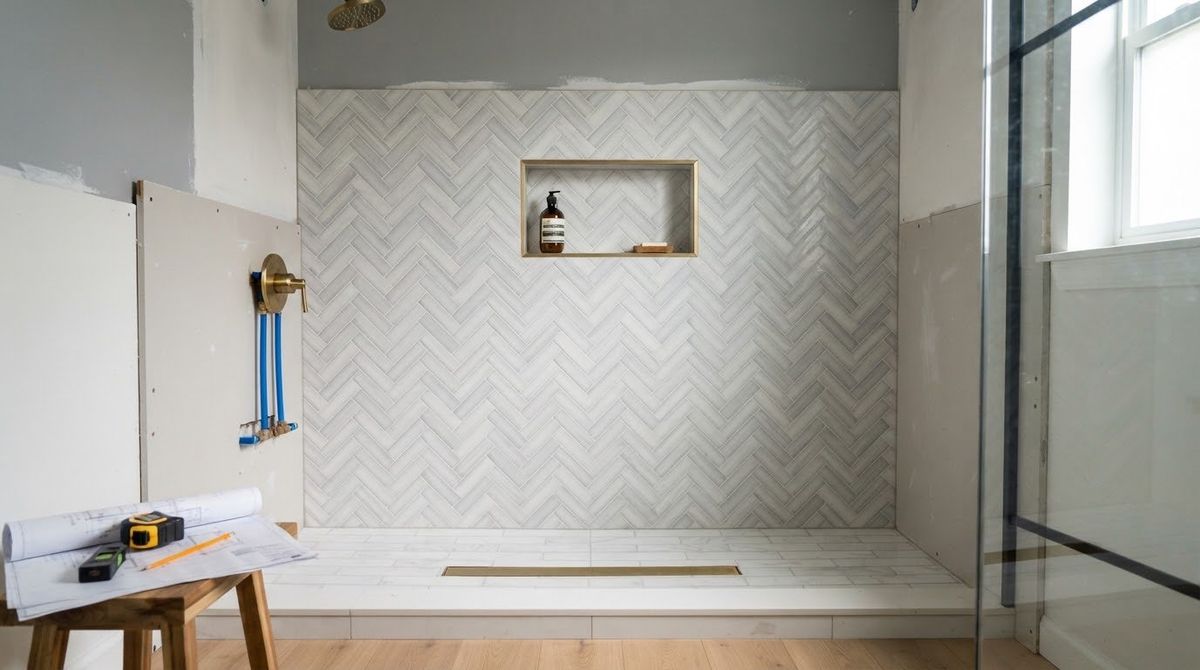
| Herringbone | Dynamic, textured | Floors and accent walls | High: many angled cuts |
| Diagonal (set on the angle) | Widens a small floor | Floors | Higher: extra cuts and waste |
| Vertical stack | Draws the eye up | Shower walls | Moderate: lines must be plumb |
| Mosaic or hex | Textured, traction | Shower floors, accent niches | Moderate: more grout to seal and clean |
The Cost vs. Value reports show how contractors price typical bathroom jobs. The midrange 2025 remodel uses a 4-by-4-inch ceramic tile surround and a ceramic tile floor, and the upscale project uses tile walls with an accent strip and larger matching floor tiles laid on the diagonal. Those are reference specifications, not recommendations for your room.
Which pattern suits a small bathroom?
A small bathroom looks calmest with one tile family and a simple layout. Running the same floor tile into the shower floor (with a suitable size and slope) removes visual breaks, and a single-color wall tile keeps the room from feeling busy. Save a bold pattern for one surface, such as a shower niche or a single wall. Small-space upgrades that make rooms feel bigger covers related ideas.
How do large format tiles change the design?
Large tiles mean fewer grout lines and a cleaner look, but they demand a flatter surface and more careful setting. The TCNA recommendations summarized by Custom Building Products apply to tile with one edge longer than 15 inches.
- Flatness. The standard recommends a substrate with no more than 1/8 inch of variation in 10 feet and no more than 1/16 inch in 24 inches. A floor outside this tolerance needs patching, leveling or grinding.
- Mortar. Mortars rated for large and heavy tile are recommended when the finished mortar bed will exceed 3/16 inch.
- Offsets. A running bond layout of tile with an edge longer than 18 inches is limited to a 33 percent offset.
- Grout joints. The grout joint width should be three times the variation in the tile’s face dimension and never less than 1/16 inch.
These numbers come from a manufacturer’s summary of the industry guidance, so ask your installer to follow the current TCNA Handbook for your assembly. Large tiles also change how a shower floor slopes, so ask the installer how they will build the pan.
How should bathroom tile be waterproofed?
Tile and grout are not waterproof, so a shower needs a waterproofing layer behind the tile. The International Residential Code, Section R307.2, requires shower and tub-surround walls to have a nonabsorbent finish extending at least 6 feet above the floor.
A common method is a liquid-applied or sheet membrane over the backer board and shower floor. Custom Building Products states that its RedGard membrane is listed with IAPMO for use as a shower pan liner and calls for a flood test after the membrane dries. Other manufacturers publish their own steps. Whatever system you choose, follow its data sheet, because the warranty and the result depend on it.
The same data sheet reminds installers to carry movement joints through the tile rather than bridging them. In practice, flexible sealant goes in the locations the TCNA Handbook specifies, in place of rigid grout.
Our guide to installing a walk-in shower describes how the pan, drain and curb fit together, and bathroom tiling: a DIY project worth attempting? explains which parts of tile work you can safely do yourself.
What do grout and trim contribute to the look?
Grout color and joint width change how a pattern reads, so choose them with the tile. A grout color close to the tile gives a seamless look, a contrasting color outlines the pattern, and wider joints show more grout.
Use sanded or unsanded grout, or a stain-resistant epoxy grout, according to the tile manufacturer and the joint width. Seal cement-based grout if the manufacturer recommends it, and use silicone caulk, not grout, at inside corners and where the tile meets the tub or shower pan. Trim pieces, such as bullnose edges and metal profiles, finish exposed edges. Choose them when you pick the tile so the thickness and color match.
How do you choose a tile layout step by step?
Work out the plan on paper before ordering tile, because layout mistakes are costly to fix after the mortar sets.
- Pick the floor tile first. Check the wet-use DCOF rating and the size that fits the room.
- Choose the shower surfaces. Decide on wall tile, a niche and a shower floor tile that suits the slope.
- Sketch the layout. Center the pattern on the focal wall, usually the vanity or the shower, and avoid thin slivers of tile at edges.
- Check the substrate. Have the floor and walls checked for flatness before you buy large tile.
- Order extra tile. Ask your installer how much extra your pattern needs, and keep spare tile from the same lot for repairs.
- Plan the waterproofing. Decide on the membrane system and who is responsible for the flood test.
- Choose grout and caulk. Pick colors and types that suit the tile and the room.
Tile is one of the largest cost items in a bathroom, so compare it with the other lines in the bathroom remodel cost breakdown. If you are tiling a kitchen backsplash at the same time, kitchen and bathroom backsplash materials covers the wall-tile choices.
Should you hire a tile setter or do it yourself?
Hire a professional for shower floors, large format tile and any layout that needs precise cuts, and consider DIY for a small, flat floor with a simple pattern. The waterproofing and flatness steps are where most failures start.
A tile setter brings tools such as a wet saw, leveling systems and notched trowels, and knows how to build a sloped shower pan. If you do part of the job yourself, follow the data sheets for every product and test the waterproofing before you tile. For the broader question of what to hire out, see when to call a pro.
| Material | Best use | Strengths | Watch for |
|---|---|---|---|
| Porcelain | Floors, shower walls and floors | Water absorption of 0.5% or less; wide range of looks, including stone and wood | Hard to cut; large sizes need a flat substrate |
| Other ceramic | Walls, backsplashes | Easy to cut and widely available | Check the wet-floor rating before using on floors |
| Natural stone | Floors and walls where you want real stone | Natural variation in color and veining | Needs sealing and care-product limits; can stain or etch |
| Glass | Accent walls, niches, backsplashes | Reflects light, does not absorb water | Shows setting-bed flaws; check manufacturer setting instructions |
| Mosaic sheets | Shower floors, niches, accents | Many grout lines add traction on slopes | More grout to clean; check the product's installation guide |
Use porcelain for floors and showers, ceramic or glass for walls and accents, and natural stone only if you accept the sealing and cleaning rules.
FAQ
What is the best tile for a bathroom floor?
Porcelain tile rated for wet floors is the most dependable choice, because its water absorption is 0.5 percent or less and it resists staining. Look for a dynamic coefficient of friction (DCOF) of at least 0.42 on the spec sheet, which ANSI A137.1 requires for level interior tile walked on when wet. A textured or smaller-format tile adds traction.
What is the difference between porcelain and ceramic tile?
The Tile Council of North America classes ceramic tile with water absorption of 0.5 percent or less as porcelain. Other ceramic tile absorbs more water, is often easier to cut and is used widely on walls. Both can work in a bathroom, but porcelain is usually the better choice for floors and shower floors. Check the product's data sheet for the stated rating.
Are large tiles slippery?
A large tile is not slippery by size alone. Slip resistance depends on the tile's surface and finish, which is why you should check the DCOF value, aiming for at least 0.42 on level wet floors. If the room has a wet floor, choose a textured finish with a DCOF of at least 0.42. Shower floors often use small tile or mosaic sheets, because the added grout lines give more grip on a slope.
What is the best tile pattern for a small bathroom?
A simple layout in a single tile color usually looks calmest in a small room. Straight (stacked) and running-bond patterns are the most forgiving, and a continuous floor and wall tile can make the room feel larger. Busy patterns, such as herringbone, add cuts and cost. Use bold patterns on one surface, such as the shower niche or accent wall.
Do I need waterproofing behind bathroom tile?
Yes. Tile and grout are not waterproof, and water can pass through grout joints. Shower walls and floors need a waterproofing system behind the tile, such as a sheet or liquid-applied membrane, applied according to the manufacturer's instructions and flood tested where the product calls for it. Check your local code, and ask your tile setter which system they use.
Can I use natural stone tile in a shower?
Yes, but it needs more care. Natural stone is porous, so manufacturers typically call for sealing and periodic resealing, and some stones stain or etch with common cleaners. Ask the stone supplier for written care instructions for your specific stone, and choose a cleaner they approve. Porcelain that looks like stone avoids most of this maintenance.
How much extra tile should I buy?
Buy more than the measured area, because cuts, breakage and future repairs all need spare tile. Straight layouts need less extra than diagonal or herringbone layouts, which create more cut waste. Ask your installer for the allowance on your layout, and keep leftover tiles from the same production lot because color can vary between lots.
Sources
- Porcelain in the Ceramic Tile Industry (Tile Council of North America) (tcnatile.com)
- Coefficient of Friction: Time Is Running Out (Tile Council of North America) (tcnatile.com)
- Successfully Installing Large Format Tile, WP103 (Custom Building Products) (custombuildingproducts.com)
- RedGard Waterproofing and Crack Prevention Membrane, TDS-104 (Custom Building Products) (custombuildingproducts.com)
- 2021 International Residential Code, Chapter 3: Building Planning (International Code Council) (codes.iccsafe.org)
- Cost vs. Value 2025: Bath Remodel, Midrange project description (Journal of Light Construction) (jlconline.com)
- Cost vs. Value 2025: Bath Remodel, Upscale project description (Journal of Light Construction) (jlconline.com)
Related articles
- How Much Does a Bathroom Remodel Cost? 2025 Cost Breakdown
Bathroom remodel cost from the 2025 Cost vs. Value report: $26,138 midrange, $81,612 upscale, what drives the price and where to save.
- Best Bathroom Upgrades in 2026, Ranked by Priority
The best bathroom upgrades in 2026, ranked: ventilation and safety first, then fixtures, lighting, vanity, tile, heated floors and smart features.
- Laundry Room Renovation: Layout and Appliance Planning
Plan a laundry room renovation around the machines: side-by-side vs stacked, vented vs heat pump dryers, clearances, power and drain, with sources.
- Powder Room Renovation Ideas: Big Impact in a Small Space
Powder room renovation ideas that fit code clearances: layout math, vanity and toilet picks, lighting, ventilation, wallpaper and tile for a half bath.
- High-Tech Bathroom Features: What to Know Before You Buy
Smart toilets, heated floors, digital showers and humidity-sensing fans: the wiring, GFCI and safety rules to know before you add bathroom tech.
- Upgrading Bathroom Fixtures: Faucets, Showerheads and Finishes
How to upgrade bathroom fixtures: choose faucet, showerhead, toilet and lighting finishes, match valves and rough-ins, and know when to call a plumber.