Starting a new construction venture is an exciting step. One of the first and most critical choices you’ll make is how to manage the process. This decision sets the stage for your entire experience.
Two primary paths dominate the industry. Your selection between them directly influences your budget, timeline, and the final quality of your work. It also shapes your relationship with the team bringing your vision to life.
This choice applies whether you’re planning a home renovation, a custom house, or a commercial space. The core principles remain the same across different project types. Understanding the distinctions empowers you to make a confident decision.
Both approaches have proven successful for countless property owners. The “best” option isn’t universal; it depends entirely on your individual priorities. Factors like your desired level of control and how you prefer to communicate are key.
Our goal is to provide a clear, unbiased comparison. We want you to feel equipped to select the method that aligns perfectly with your specific needs and expectations for a successful outcome.
Key Takeaways
- The choice of construction method significantly impacts your project’s budget, schedule, and final quality.
- This decision is relevant for a wide range of projects, from residential homes to commercial buildings.
- There is no single “best” option; the right choice depends on your personal priorities and project details.
- Key factors to consider include your desired level of control over the process and communication preferences.
- Understanding the fundamental differences between these two paths is essential for making an informed decision.
- A well-informed choice leads to a smoother experience and a final result that meets your expectations.
Overview of Construction Approaches
Two distinct methodologies have shaped how construction projects are managed in the United States. Each offers a unique framework for bringing architectural visions to life.
Understanding Design-Build and Traditional Methods
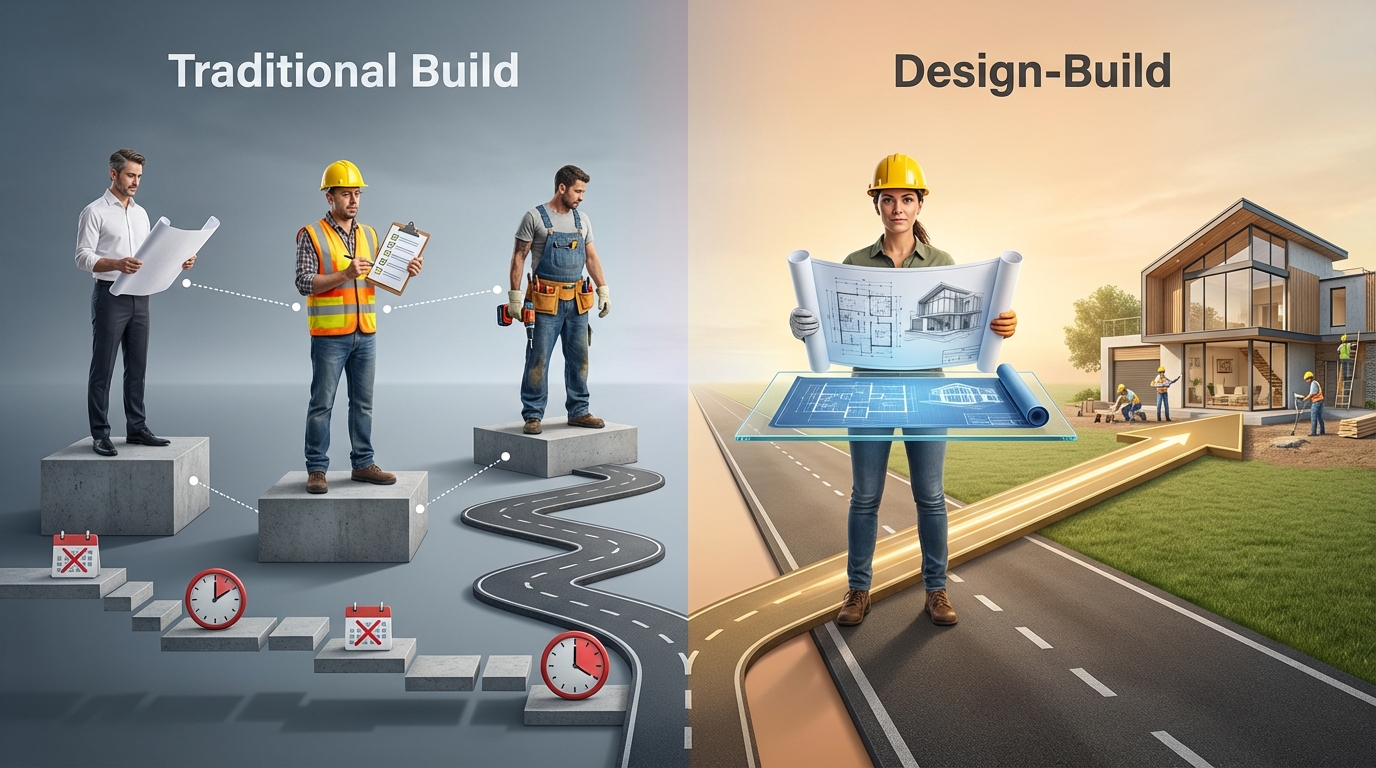
The conventional approach separates planning and execution into distinct stages. An architect creates complete blueprints before contractors bid on the project.
This sequential process ensures detailed planning but can create communication gaps. The integrated method combines these phases under one team.
| Feature | Conventional Method | Integrated Approach |
|---|---|---|
| Team Structure | Separate designer and contractor | Single unified team |
| Communication Flow | Through scheduled meetings | Continuous collaboration |
| Accountability | Split between parties | Single point of contact |
Historical Context and Evolution in the United States
The separated method dominated American construction for most of the 20th century. It established clear roles but sometimes created coordination challenges.
“The integration of planning and construction represents one of the most significant evolutions in modern project management.”
Complex projects often benefit from professional oversight. Some renovations should always be done by to ensure quality results.
Both approaches continue evolving with new technologies. They adapt to meet changing client needs and project requirements.
Inside the Design-Build Process
Imagine having one point of contact for your entire construction journey—that’s the core promise of the design-build process. This integrated method brings together planning and execution under one unified team.
Unified Team and Single Point of Accountability
With this approach, a single firm manages your entire project from start to finish. Clients work with one cohesive team responsible for both creative planning and physical construction.
The design-build team operates with shared goals and mutual accountability. This eliminates finger-pointing between separate parties when challenges arise.
| Aspect | Design-Build Approach | Client Benefit |
|---|---|---|
| Team Structure | Single unified firm | One point of contact |
| Accountability | Shared responsibility | Reduced coordination burden |
| Communication Flow | Continuous collaboration | Real-time updates |
| Project Phases | Overlapping timelines | Faster completion |
Streamlined Communication and Overlapping Phases
Communication flows efficiently when designers and builders work side-by-side. This allows for real-time problem-solving without lengthy delays.
The construction process benefits from overlapping phases. Site preparation can begin while interior details are finalized.
This collaborative environment fosters innovation and efficiency. For a deeper understanding of how this compares to other methods, explore the key differences between design-build and traditional.
Design Build vs Traditional: Key Differences
When weighing your construction options, the fundamental differences in project management become immediately apparent. These distinctions directly influence your budget, schedule, and peace of mind.
Let’s break down the core contrasts across the most critical factors for a successful outcome.
Comparing Project Timelines and Cost Implications
The integrated approach often leads to a faster completion. Work can start before all plans are final, like site preparation.
This overlapping of phases can shave weeks off the total timeline. Early coordination also helps spot potential issues before they become expensive problems.
The sequential method requires a complete blueprint before any work begins. This allows for a very clear understanding of costs upfront.
However, this linear process extends the overall schedule. Budget overruns can occur if the initial plans and construction realities don’t align perfectly.
Collaboration, Customization, and Risk Management
Collaboration is the cornerstone of the unified method. Everyone works under one contract with shared goals.
This fosters direct communication and allows for real-time adjustments. You gain greater flexibility to refine plans as the work progresses.
Risk management is also simplified. A single entity is accountable for the entire process, from initial concepts to final construction.
If a challenge arises, there is no question of responsibility. This consolidated accountability provides significant peace of mind for the property owner.
Advantages and Challenges of the Design-Build Method
Property owners considering the unified method will discover both compelling benefits and important factors to weigh. This approach reshapes how projects unfold from concept to completion.
Enhanced Efficiency and Faster Project Delivery
The integrated framework delivers remarkable efficiency by eliminating redundant coordination between separate entities. Everyone works toward shared goals from day one.
This collaboration enables faster project timelines through overlapping phases. Site work can begin while final details are perfected, saving valuable time.
Early teamwork also identifies potential issues before they become expensive problems. This proactive approach often results in better quality outcomes that meet client needs precisely.
Potential Drawbacks and Cost Considerations
The main challenges involve cost structure and trust requirements. Upfront pricing may appear higher than traditional bids since services are bundled together.
Clients must place confidence in one team for both creative and technical execution. Finding the right partner requires careful vetting to ensure balanced capabilities.
However, many find that the advantages outweigh initial concerns. For large projects, exploring cost-effective strategies for large-scale renovations can maximize value within your budget.
Traditional Construction: Process and Pros/Cons
Working with multiple specialized firms offers distinct advantages for certain types of construction projects. This approach provides clear structure and predictable outcomes.
The Separate Phases: Design, Bidding, and Construction
This method unfolds in three distinct stages. First, you collaborate with an architect or designer to create detailed plans.
The bidding phase follows design completion. Multiple contractors review the same documents and submit competitive prices.
This competitive process can help manage your project costs effectively. Construction begins only after selecting the right contractor.
Reliability, Oversight Needs, and Timeline Impacts
The sequential nature provides reliability through specialized expertise. Each firm focuses on their specific phase with deep experience.
However, this separation requires significant owner coordination. You’ll need to manage communication between different teams.
Project timelines may extend since each phase must finish before the next begins. Careful oversight helps maintain quality throughout the process.
This approach works well for straightforward projects with clear scope. It gives owners maximum control over each decision.
Factors to Consider When Choosing Your Construction Approach
Before committing to a construction method, several key factors deserve your thoughtful consideration. Your choice should align with your personal preferences and project requirements.
Budget, Project Complexity, and Desired Owner Involvement
Your budget plays a crucial role in this decision. Consider both upfront cost and potential long-term expenses.
Complex projects with custom features often benefit from integrated approaches. Simpler construction might work well with sequential methods.
Think about how much hands-on control you want. Some clients prefer managing separate contractors, while others value single-point accountability.
Tailoring the Approach to Residential, Commercial, or Luxury Projects
Different project types have unique needs. Luxury homes often require significant flexibility for custom details.
Commercial projects might prioritize strict timelines. Residential renovations could benefit from streamlined communication.
Your choice should match your specific situation. The right approach ensures a smoother experience and better results.
Conclusion
Selecting the optimal construction framework can make all the difference in achieving your project goals successfully. Both approaches offer distinct paths to quality results.
The unified method provides excellent communication and collaboration. It works well for complex projects needing flexibility. The sequential approach offers separate phases with specialized expertise.
Neither method holds universal superiority. Your choice depends on budget, timeline, and desired involvement level. Carefully evaluate potential teams and contractors.
Have detailed conversations about your expectations before making final decisions. With proper research and clear communication, your construction project can achieve outstanding results that meet your vision perfectly.
FAQ
What is the main difference between design-build and traditional construction?
The biggest difference is the team structure. In the design-build method, one firm handles both the design and construction under a single contract. This creates a unified team. The traditional approach involves hiring an architect and a contractor separately, which can lead to more complex communication.
Which approach typically leads to a faster project timeline?
The design-build approach is generally faster. Because the design and construction phases overlap, work can start sooner. This streamlined process often results in a shorter overall project timeline compared to the traditional method’s sequential steps.
How does cost control differ between the two methods?
Cost control is often more predictable with design-build. With a single point of accountability, the team can provide early cost estimates and manage the budget more effectively. In traditional construction, costs can be less certain until the bidding phase is complete.
Is the design-build method better for complex projects?
It can be an excellent choice. The high level of collaboration and flexibility in the design-build process is well-suited for complex projects. The integrated team can quickly solve problems and adapt plans, which helps manage risk and maintain quality.
What is a potential drawback of the design-build approach?
A potential challenge is that clients may have less direct control over the design details compared to working with a separate architect. It’s crucial to choose a design-build firm with a strong reputation to ensure the final project meets your vision and needs.
When might the traditional construction method be a better fit?
The traditional method can be ideal if you want a high degree of involvement in the design phase and prefer the checks and balances of having separate architect and contractor contracts. It’s a time-tested approach that offers clear separation of duties.