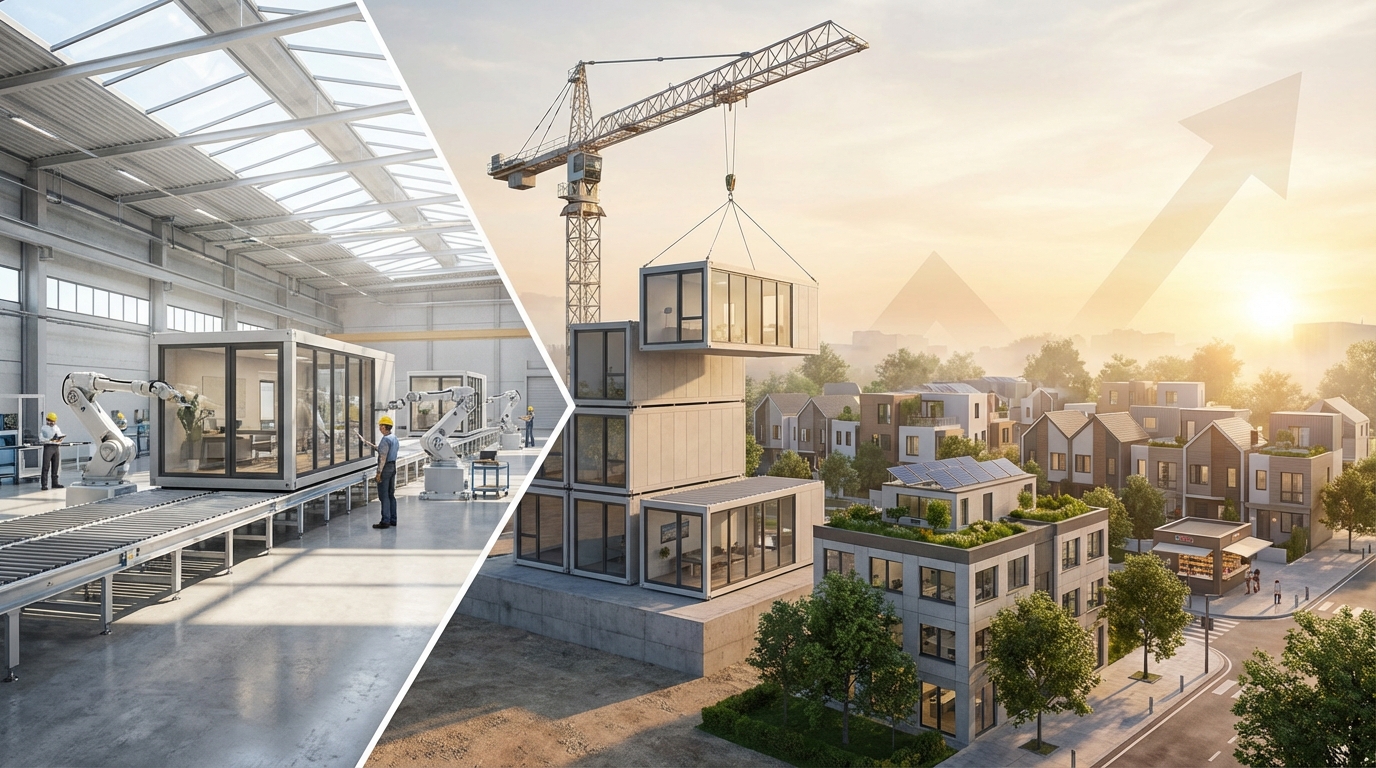
Welcome to an in-depth look at how factory-built structures are transforming the building landscape. This innovative approach is reshaping how we think about creating spaces, from homes to commercial facilities.
The prefab market is experiencing remarkable growth. According to recent data, it’s projected to expand from $104.1 billion in 2024 to $140.8 billion by 2029. Currently, this method accounts for 6.64% of new building starts.
Why does this matter right now? The industry faces significant challenges like labor shortages and sustainability demands. Factory-based production offers substantial cost savings and faster project completion while being more environmentally friendly.
This guide will explore everything from basic principles to advanced applications. We’ll break down complex concepts into easy-to-understand language that works for professionals and curious readers alike.
Key Takeaways
- The prefab building sector is growing rapidly with billions in market potential
- Factory-based production offers significant time and cost advantages
- This method addresses current industry challenges like labor shortages
- Sustainability benefits make it an environmentally conscious choice
- The approach represents a fundamental shift in how buildings are created
- Market data shows consistent growth and increasing adoption rates
Introduction to Modular and Prefab Construction
From ancient civilizations to modern times, the art of creating structures has continuously adapted to meet changing needs and technologies.
The Evolution of Construction Methods
Early building techniques relied on local materials and manual labor. Each project was unique, crafted entirely on-site with limited standardization.
Traditional approaches faced growing challenges over time. Weather delays, skilled labor shortages, and budget overruns became common issues. These problems prompted the search for better alternatives.
The construction industry began exploring factory-based solutions. This shift combined manufacturing efficiency with building expertise. It created a hybrid approach that leveraged the best of both worlds.
Key technological advancements made modern methods possible. Computer-aided design and factory automation enabled precision manufacturing. Improved transportation systems allowed for efficient module delivery.
Today’s focus on sustainability and quality control accelerated this evolution. Builders recognized the environmental and operational advantages of controlled factory environments.
This historical context helps explain why modern building represents a fundamental reimagining of project approaches. It builds on centuries of knowledge while addressing contemporary industry challenges.
Understanding Modular Construction Principles
Off-site manufacturing methods are revolutionizing the way structures come together. This approach transforms traditional building workflows through factory-based production.
What is Modular Construction?
Factory-built techniques involve creating building components in controlled environments. Workers assemble 2D panels or complete 3D volumetric units.
The process begins with careful design and engineering. Factories then produce these elements using assembly line efficiency. Finished modules travel to sites for final assembly.
Several methods exist for different needs. Permanent structures suit long-term facilities. Relocatable options work for temporary spaces. Hybrid approaches combine various techniques.
Prefab vs. Traditional Building Methods
Factory-based production differs significantly from on-site work. Controlled environments ensure consistent quality throughout the building process.
Timelines shrink dramatically with parallel workflows. Site preparation happens while factories create modules. This coordination speeds up project completion.
| Aspect | Prefabricated Building | Traditional Methods |
|---|---|---|
| Production Location | Climate-controlled factory | On-site in open weather |
| Timeline | 30-50% faster completion | Weather-dependent schedule |
| Quality Control | Consistent factory standards | Variable site conditions |
| Labor Efficiency | Specialized assembly teams | Multiple trade coordination |
Modern modular building offers impressive design flexibility. Architects can create complex visions while maintaining factory efficiency. These structures often exceed traditional strength requirements.
Benefits of Modular Construction in Today’s Industry
Modern prefabricated techniques offer concrete improvements in efficiency, safety, and environmental performance. These advantages make factory-built approaches increasingly attractive for diverse building initiatives.
Enhanced Quality, Speed, and Safety
Factory-controlled environments ensure superior quality through rigorous inspection protocols. Materials remain protected from weather damage throughout the entire process.
Projects complete 30-75% faster by working on site preparation and module fabrication simultaneously. A five-person team can assemble six 3D units covering 270 square meters in one day.
Safety improves dramatically with 80% fewer reportable accidents. Fall-related injuries drop from 48.1% to just 9.1% since most work occurs at ground level.
Environmental and Operational Advantages
Moving 80% of activity off-site reduces neighborhood disruption significantly. This approach minimizes traffic, noise, and dust around active locations like schools or hospitals.
Operational benefits include predictable timelines and efficient resource management. Weather delays become rare since manufacturing occurs in climate-controlled facilities.
| Benefit Category | Traditional Methods | Factory-Built Approach | Improvement Impact |
|---|---|---|---|
| Project Timeline | Weather-dependent schedule | 30-75% faster completion | Substantial time savings |
| Quality Control | Variable site conditions | Consistent factory standards | Superior build quality |
| Safety Performance | Higher accident rates | 80% fewer incidents | Enhanced worker protection |
| Site Disruption | Significant neighborhood impact | Minimal local disturbance | Better community relations |
Addressing Challenges and Limitations
Navigating the practical realities of prefabricated building reveals several important considerations for project success. While the benefits are substantial, this approach requires careful planning to overcome specific obstacles.
Logistical and Design Constraints
Transporting completed units presents one of the biggest logistical hurdles. Moving large, heavy components demands specialized equipment and meticulous coordination.
The financial impact of transportation is significant. Moving fabricated elements costs more than shipping raw materials to a traditional job site.
| Component Type | Transport Cost per m² | Distance Covered |
|---|---|---|
| 2D Floor Panels | $8 | 250 km |
| 3D Volumetric Units | $45 | 250 km |
| Traditional Materials | $2-4 | 250 km |
Road regulations limit module dimensions, which affects architectural planning. These constraints can influence room sizes and overall layout decisions.
There’s always a risk of damage during transit. Damaged units often require complete replacement, causing factory delays and additional expenses.
Regulatory challenges also exist. Zoning laws may treat factory-built structures differently, requiring unique approvals. Understanding both advantages and limitations helps teams prepare adequately.
Despite these challenges, proper planning typically allows the benefits to outweigh the limitations. Careful partner selection and thorough preparation make these obstacles manageable.
Innovative Manufacturing and Assembly Methods
The heart of modern building efficiency lies in sophisticated factory operations that transform raw materials into precision-engineered components. These advanced facilities operate like well-oiled machines, combining human expertise with cutting-edge technology.
Parallel Processing: Site Preparation and Module Production
One of the biggest time savers in factory-based building is parallel workflow coordination. While traditional methods follow sequential steps, modern approaches allow simultaneous progress.
Site crews can prepare foundations while factories manufacture complete units. This eliminates the waiting periods that plague conventional projects. The coordination between off-site and on-site teams becomes crucial for success.
| Workflow Type | Traditional Sequential | Modern Parallel | Time Savings |
|---|---|---|---|
| Foundation Work | Weeks 1-4 | Weeks 1-4 | No change |
| Structure Building | Weeks 5-16 | Weeks 1-12 | 4 weeks |
| Utility Connections | Weeks 17-20 | Weeks 13-16 | 4 weeks |
| Total Project Time | 20 weeks | 16 weeks | 20% faster |
“The ability to work on foundation preparation and module fabrication simultaneously represents one of the most significant breakthroughs in modern building methodology.”
Factory environments enable rigorous quality control at every production stage. Specialized equipment and standardized processes ensure consistent results. Workers follow precise protocols that would be impossible to maintain on traditional job sites.
Advanced scheduling algorithms help optimize resource allocation across multiple projects. This sophisticated planning maximizes efficiency while minimizing costs. The entire process represents a fundamental shift in how buildings come together.
Sustainability and Environmental Impact
Sustainable building practices find their perfect partner in controlled factory environments. This approach fundamentally changes how we think about resource management and environmental responsibility.
Waste Reduction and Eco-Friendly Practices
Factory-based methods generate only about 5% waste by weight. Traditional approaches typically produce 10-13% waste. This difference becomes massive on large projects.
Precision manufacturing prevents waste before it happens. Computerized cutting maximizes material usage. Exact quantities are ordered for specific units.
Transportation impacts drop dramatically. Site deliveries decrease by up to 70%. Materials move efficiently to centralized factories instead of scattered job sites.
Neighborhood disruption minimizes significantly. Noise pollution and dust reduce greatly. This benefits projects near schools, hospitals, or residential areas.
The environmental advantages extend beyond the building process. These structures often feature superior insulation and energy-efficient designs. They deliver long-term sustainability benefits.
Cost Analysis and Economic Advantages
Understanding the financial side of factory-built projects reveals compelling economic advantages. This approach transforms how budgets are managed from start to finish.
Savings, Investment, and Transportation Considerations
Factory-based methods can deliver up to 20% total project cost savings. The repetitive nature of this work makes cost predictions more accurate.
Labor expenses drop significantly when 80% of work moves to controlled environments. This reduces the need for expensive specialized tradespeople on-site.
| Cost Factor | Traditional Building | Factory-Built Approach |
|---|---|---|
| Labor Requirements | Multiple specialized teams | Consistent factory crew |
| Material Waste | 10-13% typically lost | Approximately 5% waste |
| Timeline Impact | Weather-dependent delays | Predictable scheduling |
| Transportation | Raw materials only | Finished modules ($45/m²) |
Projects with repeating designs see the greatest benefits. Hotels and student housing achieve maximum efficiency through standardization.
By 2030, this method could generate $22 billion in annual savings. It addresses the industry’s productivity gap while creating better financial outcomes.
Conclusion
As we wrap up our exploration of factory-built methodologies, it’s clear this approach represents more than just a trend. It’s a fundamental shift in how we create spaces, offering solutions to pressing industry challenges.
The evidence shows remarkable advantages: projects complete 30-75% faster with up to 20% cost savings. Quality improves through controlled factory environments, while safety incidents drop by 80%. Market growth from $104 billion to $141 billion by 2029 confirms this method’s staying power.
Success requires early commitment to the methodology during design phases. While not perfect for every situation, these systems deliver sophisticated results that rival traditional buildings. As the industry evolves, understanding these innovative approaches becomes essential for staying competitive.
The future looks bright for off-site manufacturing. Continued innovation will expand applications, making quality structures more accessible and sustainable for diverse projects.