Welcome! Choosing a new system for your home is a big decision. It affects your comfort, your utility bills, and your budget for years to come. We know this can feel overwhelming, and we’re here to help you navigate the options with confidence.
Heating for your household is a major energy user. It often makes up nearly 20% of a family’s electricity costs. This adds up to an average of $400 to $600 every year. With rising living expenses, it’s no wonder that a recent survey found 78% of Americans feel stressed about their energy bills.
While replacing your current system is a significant investment, a smart choice can lead to real savings. Models that meet the latest Department of Energy standards can save homeowners over $100 annually. Some efficient systems can even pay for themselves in just a few years.
This guide will walk you through everything you need to know. We’ll compare tankless and traditional systems in detail. Our goal is to help you find the perfect fit for your specific needs and financial situation.
Key Takeaways
- Heating water is a major expense, typically costing families hundreds of dollars annually.
- Many homeowners are concerned about high energy costs in the current economy.
- A new system is an investment, but the right choice can lead to long-term savings.
- High-efficiency models can reduce your energy use and save you money each year.
- Understanding your options now helps you avoid a rushed, stressful decision later.
Overview of Water Heating Options
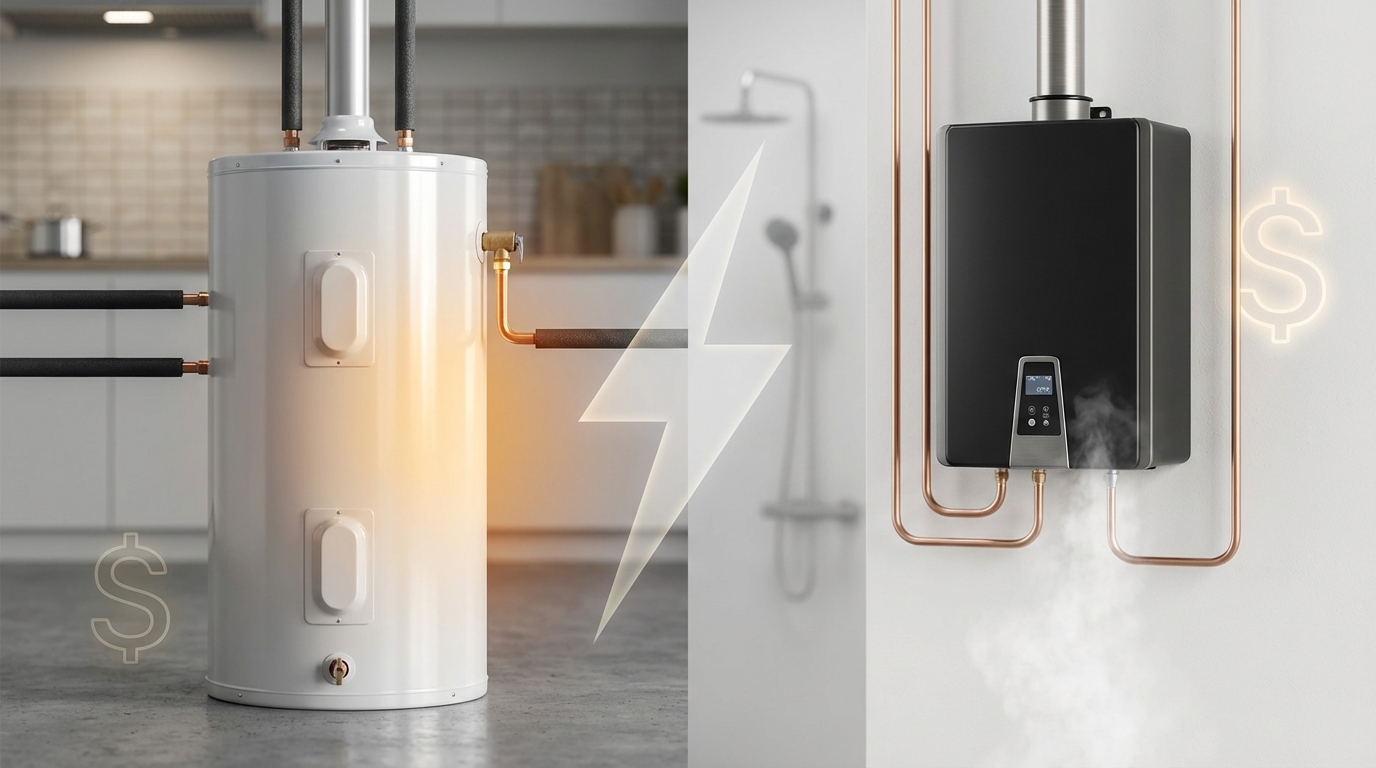
When you turn on the tap, you expect warmth instantly. But how that warmth gets there depends on your system. The two main types of water heaters are traditional tank models and modern tankless units.
Understanding this basic difference helps you make a smart choice for your home.
Understanding Traditional Tank Water Heaters
These are the most common systems in American homes. A large insulated storage tank holds 20 to 80 gallons.
It keeps this supply hot and ready at all times. When you need it, hot water is drawn from the top. Cold water enters the bottom to be heated.
This process uses energy continuously, even when no one is using the taps. This is known as standby heat loss.
You can choose a gas or electric model for this type of heater. Gas units often use natural gas or propane. Electric models rely on resistance coils.
Introduction to Tankless Water Heaters
Tankless systems work on demand. They heat water directly as it flows through the unit. There is no storage tank to maintain.
This design provides a continuous supply. You never run out of hot water. The key advantage is efficiency. By eliminating standby losses, these heaters can cut energy use by 10-15%.
However, the flow rate can be a limitation. The system’s capacity must match your household’s peak demand.
| Feature | Traditional Tank System | Tankless System |
|---|---|---|
| How It Works | Stores and constantly reheats a large volume of water in an insulated tank. | Heats water instantly as it passes through the unit, with no storage. |
| Energy Use | Energy is used 24/7 to maintain tank temperature, leading to standby heat loss. | Energy is used only when a hot water tap is open, reducing waste. |
| Hot Water Supply | Limited to the tank’s capacity; can run out during heavy use. | Unlimited in theory, but flow rate (gallons per minute) is the limiting factor. |
| Common Fuel Types | Natural gas, propane, electricity, oil. | Natural gas, propane, electricity. |
Pros and Cons of Tankless Water Heaters
For many homeowners, the promise of endless hot water and lower energy bills makes tankless systems an appealing choice. These units operate only when needed, providing significant advantages over traditional storage models.
Energy Efficiency and On-Demand Heating
Tankless systems eliminate standby heat loss by heating water instantly as it flows through the unit. This on-demand approach can reduce energy consumption by 10-15% compared to storage models.
Modern gas-fired units feature modulating technology that adjusts output from 15,000 to 180,000 Btuh. The largest models deliver approximately 5 gallons per minute—enough for two simultaneous showers.
However, these systems require minimum flow rates of 0.5-0.75 gallons per minute to activate. This can cause intermittent operation during low-flow uses like hand washing.
Space-Saving and Installation Factors
The compact wall-mounted design frees up valuable floor space. This makes tankless units ideal for smaller homes or utility areas where space is limited.
Electric models may require substantial electrical capacity—sometimes 40-60 amps at 220 volts. This could necessitate electrical upgrades in older homes.
When shopping, look for gas models with Energy Factor (EF) ratings of 0.8 or higher. Nearly all new units now use electronic ignition, further improving efficiency.
| Feature | Gas Tankless | Electric Tankless |
|---|---|---|
| Flow Rate Capacity | Up to 5 GPM | Lower flow rates |
| Temperature Rise | 77°F typical | Requires 11 kW per GPM |
| Electrical Requirements | Minimal | 40-60 amps at 220V |
| Energy Factor | 0.8+ recommended | Varies by model |
Pros and Cons of Traditional Water Heaters
While tankless units represent modern innovation, conventional storage tank systems continue to hold significant appeal for many homeowners. These familiar units work by maintaining a ready supply of heated liquid in an insulated container.
Reliability and Consistent Hot Water Supply
The primary advantage of storage tank systems is their ability to provide immediate warmth whenever you need it. They maintain a reserve that’s always ready, eliminating any wait time for the liquid to heat up.
Traditional tank models excel in households with high simultaneous demands. Families running multiple showers, dishwashers, and washing machines simultaneously benefit from this consistent supply.
These systems feature straightforward technology that most plumbers understand well. Their established reliability comes from decades of refinement and widespread use in American homes.
Energy Loss and Standing Heat Considerations
The significant drawback involves standby heat losses. Heat continuously escapes through the tank walls even when no hot water is being used. This results in ongoing energy consumption.
Distribution losses also contribute to waste. Warm liquid remaining in pipes cools down after faucets turn off. This represents additional heating energy that provides no benefit.
Newer energy-efficient models incorporate higher insulation levels to minimize these losses. The best conventional gas units achieve energy factors between 0.67 and 0.70.
For safety and efficiency, prioritize gas-fired systems with sealed combustion or power venting. These features prevent dangerous backdrafting situations where combustion gases could enter your home.
Water Heater Upgrade: Choosing the Right System for Your Home
A proactive approach to selecting your next heating solution offers significant advantages over waiting for a crisis. Many people only consider replacement when their current unit fails unexpectedly.
Key Considerations for a Water Heater Upgrade
Most heating systems last 10-15 years. If yours is aging, have a professional assess its condition now. This allows you to plan rather than react to emergencies.
Replacing an inefficient unit can be financially smart. Energy savings often pay for the new water heater within a few years. Thoughtful planning lets you choose based on long-term value.
Assessing Fuel Types and Energy Sources
Your fuel choice impacts both installation options and operating costs. Consider availability and local pricing for different energy sources.
The fuel type affects system sizing and efficiency levels. Homes without gas lines may face conversion costs. All residences have electricity access, though costs vary by region.
| Consideration | Proactive Planning | Emergency Replacement |
|---|---|---|
| Decision Time | Ample time for research | Rushed, pressured choice |
| Cost Factors | Budget-friendly options | Limited availability |
| System Selection | Ideal type for your home | Whatever is available |
| Energy Efficiency | Maximize savings | Compromised choices |
Exploring Advanced Water Heating Systems
Beyond the familiar tank and tankless options, innovative heating technologies are revolutionizing how homes maintain warm water supplies. These advanced systems leverage alternative energy sources and integrated designs for superior efficiency.
Heat Pump Water Heaters and Their Benefits
Heat pump systems work like refrigerators in reverse, moving warmth from the surrounding air into your supply. This approach uses electricity to transfer heat rather than generate it directly.
These units consume one-third to one-half the energy of conventional electric models. They perform exceptionally well in moderate to warm climates where ambient temperatures provide abundant heat energy.
You can choose integral units with built-in tanks or add-on modules for existing systems. Despite higher electricity rates in some areas, their superior efficiency often results in lower operating costs than gas-fired alternatives.
Indirect, Hybrid, and Integrated Systems Overview
Indirect systems use your home’s boiler as the heat source, circulating liquid through a separate insulated tank. When paired with high-efficiency boilers, this becomes the most economical heating method.
Hybrid gas models combine condensing burner technology with modest storage capacity. They deliver high performance without requiring large gas line modifications.
Integrated “combi” systems consolidate domestic warmth and space heating into one package. Solar options harness free renewable energy from the sun, offering substantial long-term savings in sunny regions.
While these advanced technologies require higher initial investments, they deliver exceptional energy savings and environmental benefits throughout their lifespan.
Comparison of Fuel Types and Operational Costs
Your choice of energy source for home comfort represents one of the most significant financial decisions you’ll make. This selection affects both installation requirements and your monthly budget for years to come.
Evaluating Energy Sources: Natural Gas, Electricity, and More
Electricity remains the most universally available option throughout the United States. It powers conventional storage systems, tankless models, and highly efficient heat pump units.
Natural gas serves as a popular alternative in many urban and suburban areas. This fuel typically offers lower operating costs than electricity where available.
Additional options include propane, fuel oil, and geothermal energy. Solar power provides renewable energy, particularly effective in southwestern regions.
Analyzing Fuel Costs and Efficiency Ratings
Comparing local fuel costs is essential for long-term savings. Contact your utility company for current rates and special pricing structures.
Different models use energy with varying efficiency. An electric heat pump system consumes electricity far more efficiently than standard electric resistance units.
Converting between fuel types involves additional expenses. These may include new gas lines, electrical upgrades, or venting system modifications.
Evaluating all factors together helps you balance upfront investment with operational savings. This approach ensures the most economically sound decision for your situation.
How to Prepare for a New Water Heater Purchase
Proper preparation ensures your new system meets all your comfort needs while maximizing energy savings. Taking time to evaluate your household’s specific situation leads to better long-term results.
Sizing Up Your Home’s Water Needs
Choosing the right size involves more than just tank capacity. You must understand your household’s actual consumption patterns and peak demand periods.
The Energy Factor (EF) rating helps compare different models efficiently. This standardized measure assumes daily use of 64 gallons regardless of tank size.
Smaller storage units often achieve higher efficiency ratings. Larger tanks have greater surface area, increasing heat loss through the walls.
Installation Guidelines and Housing Considerations
Assess your available space before selecting a system. Traditional units require floor area with specific clearances around them.
Tankless models mount on walls, freeing up valuable square footage. This makes them ideal for homes with limited utility room space.
Consider installation requirements like fuel source access and proper venting. Electrical capacity needs vary significantly between different types.
| Consideration | Storage Systems | Demand Systems |
|---|---|---|
| Sizing Factor | Tank capacity & first-hour rating | Flow rate & temperature rise |
| Space Requirements | Floor space with clearances | Wall mounting only |
| Ideal Household | High simultaneous demand | 1-2 occupants, coordinated use |
| Key Specification | Energy Factor (EF) rating | Minimum flow rate activation |
Incentives and Rebates for Energy-Efficient Water Heaters
Government and utility programs are making energy-efficient home upgrades more affordable than ever. Taking advantage of these incentives can significantly reduce your initial investment while lowering long-term operating costs.
Federal Tax Credits and Energy Savings Programs
The Inflation Reduction Act offers two primary tax credits for efficient systems. The Energy Efficient Home Improvement Credit provides up to 30% of your purchase and installation expenses.
You can claim up to $1,200 annually for most qualified units. High-efficiency heat pump models qualify for enhanced credits reaching $2,000 per year. These valuable savings remain available through 2032.
The Residential Clean Energy Credit targets renewable technologies like solar and geothermal systems. This program offers a 30% credit with no maximum limit, making larger installations particularly cost-effective.
State and Local Rebates for Upgrading Your System
Beyond federal programs, many states and utilities offer additional incentives. These may include direct rebates, bill credits, or special financing options.
Check your utility company’s website and state energy office for current offers. The Database of State Incentives for Renewables and Efficiency (DSIRE) provides comprehensive program information.
Combining multiple incentives can dramatically reduce your net cost. Premium efficiency models often become more affordable than standard units after all available savings.
| Program | Coverage | Maximum Benefit | Timeline |
|---|---|---|---|
| Energy Efficient Home Improvement Credit | Heat pumps, high-efficiency gas systems | $1,200-$2,000 annually | Through 2032 |
| Residential Clean Energy Credit | Solar, geothermal systems | 30% of cost (no cap) | Through 2032 |
| State & Utility Rebates | Varies by location | Typically $100-$1,000+ | Ongoing |
Conclusion
Your journey to selecting the perfect heating solution for your household culminates in understanding how different technologies align with your specific needs. Traditional storage systems offer reliable, immediate warmth for larger families, while tankless units provide energy savings through on-demand operation.
Advanced options like heat pump and solar systems represent the most efficient choices available today. Proper sizing ensures your system meets demand without wasting resources. Evaluating local fuel costs helps identify the most economical option for your situation.
Remember that substantial incentives can significantly reduce your investment in efficient technology. Planning ahead rather than waiting for emergencies allows for informed decisions based on long-term value.
Armed with this comprehensive information, you’re now prepared to confidently choose the system that best serves your household’s comfort and efficiency goals for years to come.