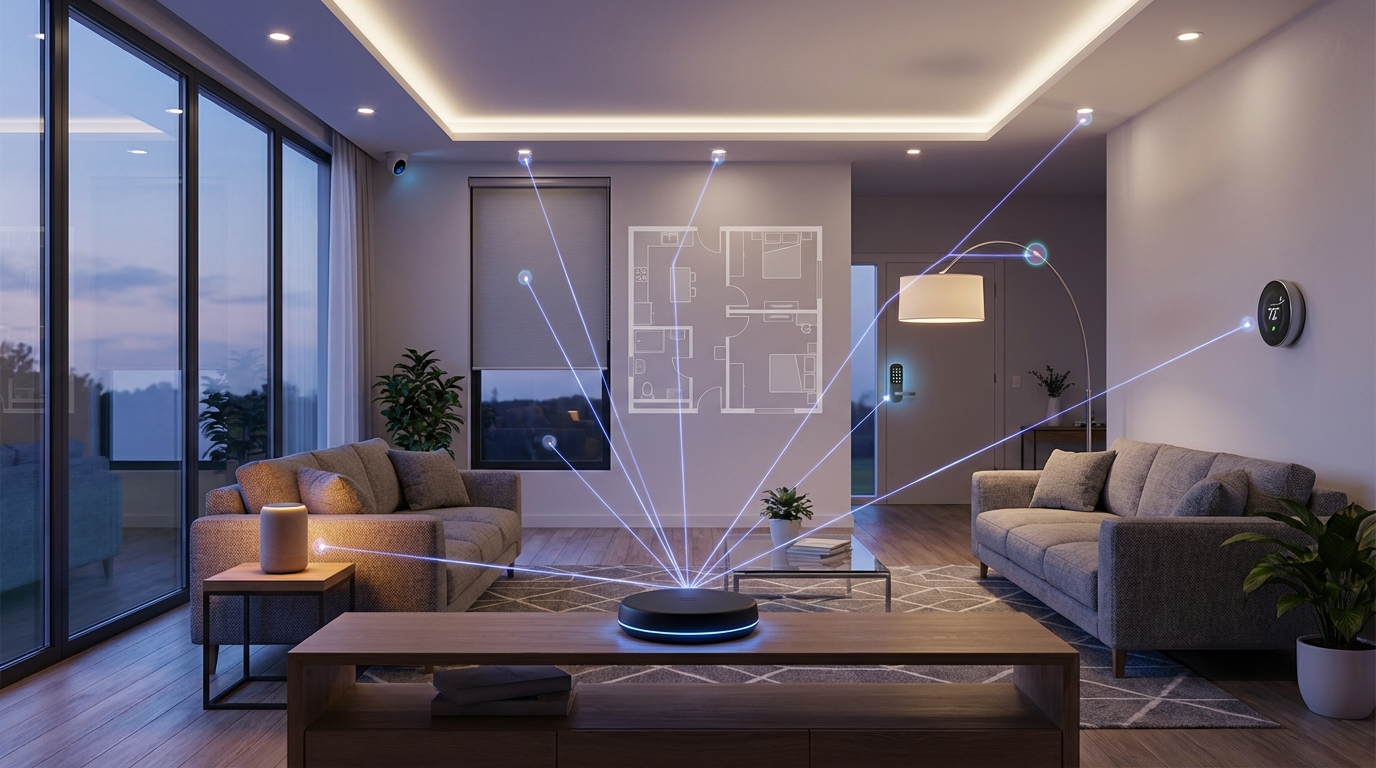
Imagine a living space that anticipates your needs. Your lights adjust as the sun sets. The temperature feels just right when you walk in. This is the promise of a connected residence.
Modern technology has moved far beyond simple timers. We now have sophisticated networks that link your gadgets. These networks create a truly intelligent environment.
Integration is the key to a smooth experience. It means all your different products work together as one. You avoid the hassle of juggling multiple apps and remotes.
A unified setup brings everything under a single command. This makes daily life more convenient and efficient. You gain better security and personalized comfort.
Building this ecosystem involves a few main parts. Hubs act as the brain. Controllers and sensors are the senses. Connected devices carry out your commands.
The best part? You don’t need to be a tech wizard. Today’s solutions are designed for everyone. This guide will show you how to get started.
Key Takeaways
- Modern networks connect many gadgets throughout your living space.
- Integration allows different products to work together seamlessly.
- Unified control simplifies management and improves the user experience.
- Key components include hubs, controllers, sensors, and connected devices.
- These technologies offer enhanced convenience, security, and energy savings.
- Current systems are user-friendly and accessible to people of all skill levels.
Overview of Whole-Home Automation Trends
Consumers today face an overwhelming array of connected gadgets, with thousands of options available. This abundance creates both incredible possibilities and significant confusion for those building their ideal living environment.
Evolving Technology in Smart Homes
Modern smart home technology is advancing rapidly. Artificial intelligence now powers more intuitive automation routines. Voice recognition has become remarkably accurate and responsive.
Edge computing processes data locally instead of relying on distant servers. This approach delivers faster response times for critical functions. It also enhances privacy by keeping sensitive information within your residence.
Wireless protocols like Thread and Zigbee work alongside Wi-Fi 6. These technologies create more reliable networks with minimal delays. Your devices communicate seamlessly throughout the entire property.
The Shift Toward Integrated Solutions
The industry is moving toward unified platforms that support numerous integrations. The Matter protocol emerges as a game-changing standard. It allows products from different brands to work together effortlessly.
Open-source solutions like Home Assistant offer exceptional versatility. They support over a thousand different integrations while prioritizing local processing. This approach gives users greater control and flexibility.
Centralized management becomes essential as households accumulate more connected devices. A single interface simplifies daily routines while enhancing security and efficiency.
The Evolution of Smart Home Devices
Early adopters of connected living faced a fragmented landscape of standalone gadgets. Each product required its own app and controller. This isolation limited their usefulness and frustrated users.
Manufacturers quickly learned from this feedback. They refined interfaces and improved reliability. Costs dropped dramatically, making these technologies accessible to mainstream consumers.
Major milestones transformed the landscape. Voice assistants arrived, changing how we interact with our environment. Mesh networks provided better coverage throughout living spaces.
Battery-powered wireless sensors eliminated wiring hassles. The variety of available products exploded beyond traditional categories. PCMag notes there’s now a smart version of virtually every household item imaginable.
Today’s offerings blend seamlessly into décor rather than standing out as obvious gadgets. ZDNET’s extensive testing helps identify which investments deliver real value. This evolution created the need for the integrated platforms we’ll explore next.
The Benefits of a Connected Home Environment
Beyond the initial novelty, connected environments provide practical advantages that make everyday routines effortless. These technologies save valuable time by handling repetitive tasks automatically.
| Benefit Category | Specific Examples | Impact Level | Real-World Application |
|---|---|---|---|
| Convenience | Auto-locking doors, motion-triggered lighting | High | Hands-free operation when carrying groceries |
| Security | Real-time alerts, remote monitoring | Critical | Peace of mind while traveling |
| Energy Efficiency | Smart thermostat scheduling | Medium-High | Reduced utility bills through optimization |
| Accessibility | Voice control, automated routines | Transformative | Independence for elderly residents |
Security enhancements offer significant protection. You receive instant notifications about unusual activity. Automated responses can lock doors or activate cameras when sensors detect motion.
Energy savings become substantial with intelligent temperature control. Products like Ecobee learn your schedule to reduce heating and cooling costs. Lighting automation ensures lights turn off in empty rooms.
Accessibility improvements help people with mobility challenges. Voice commands control various functions without physical interaction. Custom automation recipes create personalized support systems.
Morning routines demonstrate the power of integration. Your environment can gradually brighten lights, adjust temperature, and start coffee makers. This creates a seamless transition from sleep to daily activities.
The combined effect of multiple smart home devices creates synergies. Individual products work better together than separately. This interconnected approach delivers greater value than standalone solutions.
Exploring Home Automation Systems
The true magic of smart living emerges when individual components work in harmony. A central platform acts as the brain that coordinates your entire ecosystem. This integration transforms scattered gadgets into a unified experience.
You’ll encounter two main approaches to processing data. Cloud-based solutions rely on remote servers for computation. Local systems keep everything on-site for faster responses and better privacy during internet outages.
Hardware requirements vary significantly between options. Some platforms need a dedicated hub device for central control. Others run as software on existing computers or mobile devices.
Three primary categories dominate the market landscape:
- Open-source platforms like Home Assistant offer maximum flexibility
- Brand-specific ecosystems provide seamless integration within one manufacturer
- Universal systems bridge multiple brands through standardized protocols
ZDNET identifies Home Assistant as a top choice for its open-source nature and extensive compatibility. The $159 Home Assistant Green hub simplifies setup, while tech enthusiasts can install it on Raspberry Pi or other hardware.
Consider your technical comfort level when selecting a platform. Initial investment, ongoing costs, and future expansion potential all matter. The right system should grow with your needs without overwhelming you.
These platforms create rules and scenes that trigger coordinated actions. Schedules, sensor inputs, or manual commands can activate multiple devices simultaneously. This coordination delivers the seamless experience modern users expect.
Integration and Compatibility Across Platforms
Choosing the right control platform determines how smoothly your smart devices work together. The three major ecosystems—Apple HomeKit, Amazon Alexa, and Google Home—each offer distinct advantages.
Apple HomeKit, Amazon Alexa, and Google Integration
Apple HomeKit stands out for privacy-conscious users. It runs on HomePod mini or Apple TV and features a simple app interface. Strict data controls ensure your information stays secure. However, it only works with certified devices.
Amazon Alexa supports thousands of products across multiple protocols. Voice control capabilities are exceptional. The trade-off comes with a cluttered app interface and privacy concerns for some users.
Google Home provides an intuitive experience similar to Apple’s approach. It enjoys broad compatibility and strong appeal for Android users. The platform supports numerous devices plus the Matter standard.
The Matter protocol now enables cross-platform compatibility. Devices certified for Matter can work across all three ecosystems simultaneously. This eliminates the worry about brand lock-in.
Your decision should consider existing devices, privacy priorities, and preferred interaction methods. Some advanced users even combine platforms, using each for its strengths.
Integration services can bridge different ecosystems when needed. This flexibility allows you to create a personalized setup that matches your lifestyle perfectly.
The Power of Voice Control in Smart Homes
Voice commands now serve as the primary interface for many modern households. This technology has transformed complex operations into simple conversations.
Natural language interaction makes advanced features accessible to everyone. You no longer need technical expertise to control your environment.
Advanced Voice Assistant Features
Amazon Alexa leads the market with exceptional accuracy and responsiveness. It supports creative commands like turning off lights when detecting snoring.
Google Assistant provides comparable voice control capabilities. Both assistants understand context and follow-up questions naturally.
Routine creation represents the most powerful feature. Single voice commands can trigger multiple actions across different devices simultaneously.
| Feature | Amazon Alexa | Google Assistant | Best Use Case |
|---|---|---|---|
| Accuracy Rating | Excellent | Very Good | Complex commands |
| Response Time | Under 1 second | 1-2 seconds | Quick actions |
| Natural Language | Advanced | Advanced | Conversational interaction |
| Routine Support | Extensive | Comprehensive | Multi-device coordination |
Voice control offers significant accessibility benefits. People with mobility challenges can operate their entire living space hands-free.
For deeper insights into this technology, consider exploring the power of voice assistants in modern setups.
Privacy remains an important consideration with always-listening devices. Most systems allow you to manage recordings and opt out of data sharing.
Optimize your experience with proper device placement and custom wake words. Training assistants to recognize different household members improves accuracy for everyone.
Enhancing Security with Home Automation
Your front door now serves as the intelligent gateway to your entire property’s protection. Modern security systems transform basic alarms into comprehensive monitoring networks that actively respond to potential threats.
Smart Locks, Video Doorbells, and Surveillance
Smart locks eliminate traditional key management worries entirely. The Ultraloq Bolt Fingerprint model supports multiple entry methods including voice commands and fingerprint recognition. You can grant temporary access codes to guests while maintaining detailed entry logs.
Video doorbells like the Arlo model provide your first line of defense. They deliver clear HD or 2K video with a 180-degree field of view. This technology allows visual verification and two-way communication with visitors before opening your door.
Surveillance cameras have evolved significantly with features like color night vision. The Aqara Camera Hub G3 Pro offers AI-powered motion detection that distinguishes between people and ordinary movement. This reduces false alarms while ensuring genuine threats receive immediate attention.
Professional monitoring services like ADT Command provide 24/7 oversight through their smart panel and mobile app. For DIY enthusiasts, SimpliSafe offers flexible self-monitored options without monthly fees. Both approaches integrate seamlessly with voice control platforms like Alexa.
The true power emerges when devices work together. Cameras can begin recording when doors open unexpectedly. Lights may activate during alarm events to deter intruders. This coordinated response creates layered security that adapts to your specific needs.
Innovative Features in Leading Smart Home Products
Manufacturers are pushing boundaries with AI-powered features that anticipate user needs. Premium smart home devices now offer capabilities that distinguish them from basic connected gadgets.
Vivint’s security cameras use artificial intelligence to detect and actively deter intruders. Their equipment is designed in-house for tight integration. This approach ensures seamless performance across the entire ecosystem.
Cleaning robots have evolved significantly. The Ecovacs Deebot X8 Pro Omni features a self-emptying dustbin and self-refreshing mop. It even includes a built-in voice assistant for hands-free control.
iRobot’s Roomba j9+ addresses common concerns with its unique POOP guarantee. This innovation prevents the device from spreading solid pet waste. It demonstrates how manufacturers solve specific user pain points.
Sleep technology has advanced remarkably. The Sleep Number 360 i8 Smart Bed allows independent firmness adjustment for each side. It tracks sleep trends to optimize rest quality throughout the night.
Temperature control reaches new levels with the Eight Sleep Pod Pro Cover. This smart device adjusts bed temperature from hot to cool based on personal preferences. It represents the growing focus on health and wellness features.
Air quality monitoring becomes sophisticated with products like the Dyson Big+Quiet Formaldehyde BP03. This device combines three-stage HEPA purification with an oscillating fan. It detects and removes harmful chemicals from your environment.
Pet owners benefit from interactive features in devices like the Furbo 360 Dog Camera. It offers barking notifications and remote treat-tossing capabilities. These innovations justify premium pricing while delivering exceptional convenience.
The rapid pace of technological advancement ensures tomorrow’s products will offer even more impressive capabilities. Today’s cutting-edge features represent just the beginning of what’s possible in connected living spaces.
Customization and Personalized Automation
The real power of modern technology emerges when you tailor it to your unique daily patterns. Moving beyond basic controls lets you create a living space that truly understands your needs.
Platforms like ADT+ and Vivint offer sophisticated tools for this personalization. Their apps allow you to create automations triggered by specific events or schedules.
Setting Up Custom Automations
Start by identifying repetitive tasks in your routine. The ADT+ app demonstrates how simple this can be. You can program your front door to lock automatically when you arm the security system.
Conditional logic creates intelligent responses. For example, set your thermostat to adjust when you leave the house. Motion sensors can arm themselves at specific times each night.
Vivint offers particularly advanced options with Z-Wave and Zigbee integration. During testing, smart bulbs were programmed to turn on at sunset and change color during alarms. This shows how creative you can get.
| Automation Type | Platform Example | Trigger Event | Resulting Actions |
|---|---|---|---|
| Security | SimpliSafe Recipes | 8:30 AM Weekdays | System arms automatically |
| Energy Saving | ADT+ Settings | Leaving Home | Thermostat adjusts to 80° |
| Convenience | Vivint Integration | Sunset/Sunrise | Lights turn on/off |
| Emergency | Zigbee Bulbs | Alarm Triggered | Lights switch to red |
Optimizing Device Connections
Reliable connections ensure your automations work smoothly. Place your central hub in a central location for best coverage. This helps all your devices communicate effectively.
Test each automation thoroughly after setup. Make adjustments based on what feels natural in your daily life. The goal is convenience, not complexity.
Balance automated and manual control. Keep override options easily accessible. This ensures your smart home remains helpful rather than frustrating.
In-Depth Review of Top Home Automation Platforms
The platform you choose serves as the central brain of your connected environment, coordinating all your devices. This decision impacts everything from daily convenience to long-term flexibility.
Home Assistant and Open-Source Options
Home Assistant stands out as the top overall choice for tech-savvy users. This open-source solution operates locally and supports over 1,000 integrations.
The $159 Home Assistant Green simplifies setup for beginners. Advanced users can install it on Raspberry Pi hardware. Complete local control ensures privacy and eliminates subscription fees.
Comparing Apple HomeKit, Vivint, and ADT
Apple HomeKit requires a HomePod mini ($99) or Apple TV 4K ($129). It offers a privacy-first approach with seamless Apple ecosystem integration.
Professional options like Vivint and ADT Command provide comprehensive security systems. Vivint costs $1,200+ for equipment with $49 monthly monitoring. ADT starts at $349 with monitoring from $29.99 per month.
| Platform | Initial Cost | Monthly Fee | Best For |
|---|---|---|---|
| Home Assistant | $159+ | $0 | Tech enthusiasts |
| Apple HomeKit | $99+ | $0 | Apple users |
| ADT Command | $349+ | $29.99+ | Professional monitoring |
| Vivint | $1,200+ | $49+ | Advanced customization |
“The right platform matches your technical comfort level and long-term goals.”
SimpliSafe offers another alternative with packages starting at $250. It includes free self-monitoring options for budget-conscious users.
How Automation Simplifies Daily Routines
Your daily schedule becomes smoother when technology handles routine tasks automatically. These programmed actions eliminate repetitive decisions that drain mental energy throughout the day.
Time-Saving Automation Recipes
Create morning sequences that gradually brighten lights and adjust your thermostat. Amazon Alexa Routines can coordinate these actions with a single voice command.
Departure sequences automatically lock doors and arm security when you leave. Testing shows these smart home features provide peace of mind while saving precious minutes.
Robot vacuums like the TP-Link Tapo RV30 Max Plus clean floors on a schedule. This hands-off approach gives you back valuable for more important activities.
Enhancing Energy Efficiency and Comfort
The Ecobee Smart Thermostat uses remote sensors to maintain consistent temperature. It learns your patterns to reduce energy waste in empty rooms.
Program lighting to follow sunset and sunrise schedules. This way you enjoy perfect ambiance while minimizing electricity usage.
The CDC recommends sleeping temperatures around 65-68°F. Smart climate control maintains this range automatically for optimal rest.
Discover more about smart home devices that actually improve daily through practical implementations. Start with simple schedules and gradually add conditional rules as you become comfortable.
The goal is creating an environment that supports your lifestyle effortlessly. These small adjustments compound into significant quality-of-life improvements over .
Real-World Experiences with Smart Home Integration
Testing a smart setup in a real house reveals practical truths. ZDNET experts installed dozens of platforms in a 2,200-square-foot residence. Their hands-on approach provides genuine insights beyond specs.
Installation experiences vary widely. SimpliSafe’s battery-operated setup took just 30 minutes. Frontpoint, being 100% wireless, was also under an hour.
In contrast, Vivint often requires professional help. ADT offers both DIY and pro options, with professional service starting around $100.
The user experience heavily depends on the app. Testers found the ADT+ app polished and intuitive. Amazon’s Alexa app, however, felt cluttered by comparison.
Hub functionality also differs. Vivint’s Smart Hub can control devices and show camera footage. ADT’s touch screen keypad focuses primarily on security.
| Installation Type | Time/Cost | Key Finding |
|---|---|---|
| DIY (SimpliSafe) | ~30 minutes | Quick, user-friendly setup |
| Professional (Vivint) | Scales with items | Seamless but requires scheduling |
| Mixed (ADT) | DIY or $100+ pro | Flexibility for different users |
Families often discover new uses over time. Children love voice-controlled lights. Elderly members appreciate simplified controls.
Common challenges include devices losing connection and software updates. These real-world stories help set accurate expectations for your own project.
Expert Tips for Investing in Home Automation Technology
Smart technology investments require careful planning to maximize value and avoid overspending. Understanding the full financial picture helps you build a system that grows with your needs.
Budget Considerations and Value Features
Start by comparing total ownership costs across different platforms. ADT packages begin at $349 with professional monitoring from $29.99 per month. Vivint requires a larger initial investment of $1,200+ with $49 monthly fees.
SimpliSafe offers more flexible options with packages from $249 to $729. Their monitoring starts at $21.99 per month with a free self-monitoring alternative. This variety lets you match spending to your specific requirements.
Installation costs significantly impact your budget. Vivint charges $99 that scales with the number of items. ADT provides both DIY and professional options, while SimpliSafe and Frontpoint focus on easy self-setup.
Look for value beyond the initial price tag. ADT’s six-month money-back guarantee provides peace of mind. Vivint’s three-day cancellation window offers less protection. Refurbished equipment from SimpliSafe starting at $413 can reduce costs.
Financing options like ADT’s 60-month plans make premium equipment more accessible. Month-to-month contracts from Frontpoint provide flexibility without long-term commitments.
Focus on products you’ll actually use daily rather than impressive-sounding features. Core security devices and climate control typically deliver the most practical benefits. This approach ensures your investment pays off through real convenience.
Future Trends in Whole-Home Automation
The next wave of intelligent living spaces will operate with even greater independence and awareness. Artificial intelligence will enable your environment to anticipate needs before you voice them.
The Matter protocol emerges as a game-changing standard. It allows products from different brands to work together seamlessly. This universal compatibility eliminates frustrating compatibility concerns.
Health-focused innovations represent another major trend. Sleep-tracking mattresses and air quality monitors become standard features. These devices provide valuable wellness insights.
Connectivity improvements will support a growing number of smart home devices. 5G and Wi-Fi 6E technologies enable faster, more reliable connections. This ensures smooth operation even with dozens of connected items.
| Trend Category | Key Technology | Real-World Impact |
|---|---|---|
| Compatibility | Matter Protocol | Universal device integration |
| Intelligence | AI Processing | Proactive environment adjustments |
| Connectivity | Wi-Fi 6E/5G | Support for more devices |
| Sustainability | Energy Management | Reduced environmental footprint |
PCMag notes there’s now a smart version of practically every household item imaginable. This expansion into new product categories offers more customization options than ever before.
Looking ahead, ambient computing may respond to presence without explicit commands. Augmented reality interfaces could revolutionize how we interact with our environments. The future promises truly intuitive living spaces.
Strategies for Seamless Device Integration
Building a cohesive network of devices requires careful planning to avoid compatibility headaches. Different products use various communication protocols that don’t always work together naturally.
Researching compatibility before purchasing saves frustration later. Check manufacturer specifications and user reviews for integration success stories.
Overcoming Compatibility Challenges
Your central hub plays a crucial role in bridging different protocols. Some platforms like Home Assistant work with over 1,000 integrations without requiring additional hardware.
Amazon Alexa supports thousands of products across Wi-Fi, Bluetooth, Zigbee, and Matter connectivity. This broad compatibility makes it a versatile choice for mixed-device environments.
Vivint integrates with Z-Wave and Zigbee devices through their dedicated app section. Meanwhile, SimpliSafe offers limited third-party integration, primarily supporting August smart locks.
Apple HomeKit only works with Matter and HomeKit-certified devices. This approach ensures quality but limits your options compared to more open platforms.
Network infrastructure significantly impacts integration success. Place your router centrally and consider mesh networks for larger spaces. A dedicated IoT network can prevent interference with your main devices.
When devices struggle to connect, check firmware updates first. Protocol conflicts often resolve with simple software patches.
Bridge devices can connect incompatible systems when native support isn’t available. The Aqara Camera Hub G5 Pro acts as a multi-protocol hub with built-in Matter, Thread, and Zigbee support.
Choose between staying within one ecosystem or building a multi-platform setup. Universal controllers offer flexibility but require more technical knowledge.
Conclusion
The journey toward a fully integrated smart residence begins with thoughtful planning. Today’s technologies offer remarkable possibilities for creating living spaces that work harmoniously together.
Successful implementation balances technical capabilities with practical daily needs. Start with core functions that deliver immediate value, then expand as confidence grows. Modern solutions cater to users at every skill level and budget.
Integration and compatibility remain crucial considerations. Choose platforms that support seamless device communication. Voice control through Alexa or Google Assistant simplifies daily interactions.
Security systems provide essential protection while motion sensors enhance convenience. Always evaluate how platforms handle personal data to ensure privacy.
The future promises even more intuitive experiences. Begin your exploration today and discover how intelligent controls can genuinely enhance your lifestyle.